
200 EMA Secrets: Reset vs. Refuel (How to Tell the Difference)
- Erica Lorrai

- Sep 25, 2025
- 3 min read
By now, you already know the 200 EMA is your macro baseline — the guardrail that shows where the dealers are driving. But here’s the nuance most retail traders miss:
👉 Not every touch of the 200 EMA is a new cycle starting.
Sometimes it’s a reset.
Sometimes it’s a refuel.
If you can’t tell the difference, you’ll either exit too soon, flip bias at the wrong time, or miss continuation entries.

The Dealer’s Playbook
Dealers don’t just “trend” price for fun. Their job is to:
Trap retail.
Load positions.
Run the move.
Cash out.
The 200 EMA is where you can see those phases play out on a macro level. But between step 3 and step 4, there’s often a mid-cycle liquidity grab — that’s your refuel.
What’s a Reset? (The End of the Box)
A reset means the cycle is over. The dealers have rung the register, closed the play, and they’re lining up the next one.
Look for:
Exhaustion patterns (M/W top or bottom)
Divergence on TDI
Price drifting back into the 200 and then hugging sideways.
A new trap forming at the 200.

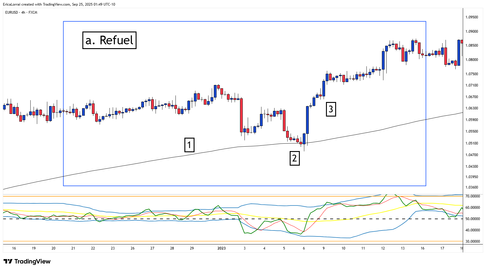
What’s a Refuel? (The Pit Stop Mid-Run)
A refuel happens inside an active cycle. The dealers are topping off the tank, grabbing liquidity from weak hands, and reloading for continuation.
Look for:
Strong slope on the 200 EMA — the trend bias is still intact.
No M/W exhaustion pattern — just a sharp bounce/ quick wick/tap into the 200 followed by rejection.
Continuation candles or new impulses immediately after.
This is not the start of a new box. It’s a pit stop.

The Trap That Gets Retail
Retail sees price touch the 200 and screams:
“Oh! New trend! It’s a reset!”
So they flip positions… right into the continuation.
Dealers eat their stops, refill the move, and the original trend keeps running.
This is why traders keep saying things like
“every time I flip, the market goes against me.”
It’s not bad luck — it’s misunderstanding the difference between a reset and a refuel.
How to Tell the Difference (Reset vs. Refuel Checklist)
Check the slope.
Rising 200 + bounce = refuel.
Flat/turning 200 + sideways = reset.
Check the pattern.
No exhaustion, just tap → refuel.
M/W exhaustion → reset.
Check the behavior.
Sharp rejection = refuel.
Hugging sideways = reset.
Check the bigger box.
If you haven’t had a full trap → move → exhaust cycle, odds are it’s a refuel.
If the cycle already played out, odds tilt reset.



Why It Matters
Trade management: Spotting a refuel keeps you in winning trades longer (instead of bailing early).
Entry precision: Refuels are amazing continuation entries if you’re trading with bias.
Bias clarity: Resets stop you from forcing trades in the wrong direction.
Confidence: Once you understand this nuance, you stop second-guessing every touch of the 200.
Advanced Insight: Timeframe Stacking
The reset vs. refuel game gets even clearer when you combine EMAs across timeframes:
200 EMA (3H/4H): Macro cycle context.
50 EMA (1H/15M): Intraday continuation refuels.
13 EMA (5M/15M): Entry timing inside those refuels.
What looks like a “reset” on the 15M often shows up as just a refuel when you zoom out to the 200 on the 4H.
Quick Takeaway
Reset = end of the box. M/W exhaustion + hugging the 200 sideways.
Refuel = pit stop mid-move. Quick dip into the 200, reject, and run again.

Tip from E~: Don’t mistake a pit stop for the end of the trip. If the 200 EMA slope is intact and the cycle hasn’t fully played out, you’re watching a refuel. Ride it, don’t fight it.


Comments