
Topstep vs Apex for Trading S&P Futures (ES & MES)

Updated: 6 days ago
Can you trade the S&P 500 with a prop firm instead of your own money? And if so, which one?
Yes, you can trade the S&P 500 through a futures prop firm. Topstep and Apex both let you trade the E-mini (ES) and the Micro E-mini (MES). The real question is which one, and that comes down to one rule you will want to knw.
Here's how I got here. I've traded EURUSD for a long time but I heard that The Dealer Cycle behaves cleaner on ES, and I wanted to test that for myself but I didn't want to fund a futures account out of pocket just to run an experiment.
You know I love the perks of a prop firm, so I went into the rabbit hole. Every firm says "$50K account!" in giant letters, and every YouTube video is about a version of the rules that no longer exists. Lame.
It ultimately came down to Apex and Topstep. I know Apex doesn't like to pay out at times (take your profits quickly is that point) and I've never traded with Topstep and knew nothing about them.
So I sorted it out for you and here is what I came up with.
First: ES vs MES
If you are coming from forex, you likely have no idea about futures. Let me catch you up.
ES is the CME ticker for the E-mini S&P 500 futures contract. The "E" comes from "E-mini," which stood for electronic mini, because it was the smaller contract that traded electronically, back when the big original S&P contract still traded in a physical pit. The "S" is for S&P.
MES follows the same pattern: Micro E-mini S&P 500.
MES is the small one. ES is the big one. One ES equals ten MES.
Same index, same chart, same tick size. The only difference is how much each point is worth. You will be trading MES. Minis!
MES (Micro E-mini) | ES (E-mini) | |
Value per 1 point | $5 | $50 |
Minimum move | 0.25 point | 0.25 point |
Value per tick | $1.25 | $12.50 |
10-point move | $50 | $500 |
20-point move | $100 | $1,000 |
30-point move | $150 | $1,500 |
If you're coming from forex, think of it like lot size-you're just choosing how much horsepower to attach to it.
Say you buy at 6700, stop at 6690, target 6725. That's a 10-point stop and a 25-point target. Remember Points not Pips and I'd place a few paper trading trades to see what it looks like in real time. It gets interesting quick.
Size | Risk | Target |
1 MES | $50 | $125 |
2 MES | $100 | $250 |
5 MES | $250 | $625 |
1 ES | $500 | $1,250 |
We are executing MES while we watch the ES chart. MES lets me turn the dial up slowly. ES takes you from a "cute little trade" to " fml I need to go back to my day job."
So just remember: ES is the market I'm trading. MES is my position-sizing tool.
Okay, back to the topic- what prop firm are we choosing.
Topstep $50K: what it costs and what you actually get
Topstep's $50K Trading Combine costs $49 a month on the Standard path, plus a one-time $149 fee when you pass and activate your funded account. Or you can pay $95 a month and skip the activation fee entirely. Same rules either way, and you can't switch paths after you buy. I recommend the first option- especially if you want to take your time. (Topstep pricing)
Topstep $50K Combine | |
Monthly fee | $49 Standard / $95 No Activation Fee |
Funded activation | $149 Standard / $0 No Activation Fee |
Reset | $49 Standard / $95 No Activation Fee |
Profit target | $3,000 |
Maximum Loss Limit | $2,000, trailing on end-of-day balance |
Max position | 5 ES / 50 MES |
Consistency | Best day under 50% of total profit |
Time limit | None |

The $2,000 is the whole story
Ignore the "$50,000" lettering. For risk purposes, you have a $2,000 account.
You start at $50,000 and you can't touch $48,000. That floor trails up as your end-of-day balance climbs. Run your normal 10-point stop against it:
Size | Risk on a 10-pt stop | % of your $2,000 |
1 MES | $50 | 2.5% |
2 MES | $100 | 5% |
3 MES | $150 | 7.5% |
1 ES | $500 | 25% |
5 ES | $2,500 | 125% |
Read that last row again. Topstep allows five ES. Five ES on a 10-point stop is more than your entire drawdown. "Allowed" and "smart" are not the same word.
The consistency rule matters too. On a $3,000 target, no single day can be more than half your profit. One giant day won't pass you by itself, so plan on several steady days.
Apex $50K: same idea, different machinery
Apex does the same basic thing as Topstep. Pay for an evaluation, hit the target without blowing the drawdown, get a funded Performance Account (PA), take payouts. ES and MES are both on the menu.
But Apex rebuilt its whole program on March 1, 2026. So if you're watching an Apex video from 2025, close it. Half those rules don't exist anymore. (Apex rules, checked Oct 2026)
The biggest shift: Apex is now a one-time fee, not a monthly subscription. You get 30 days. No resets. If you blow it or run out of time, you buy a new one.
Apex $50K Evaluation | Intraday Trail | EOD Trail |
Profit target | $3,000 | $3,000 |
Max drawdown | $2,000, trails in real time | $2,000, trails at day's close |
Daily loss limit | None | $1,000 (pauses your day, doesn't fail you) |
Max position | 6 ES / 60 MES | 6 ES / 60 MES |
Minimum days | None | None |
Consistency rule | None in the evaluation | None in the evaluation |
Time limit | 30 days, no resets | 30 days, no resets |
What it costs
Honestly? It depends on the day. Apex lists the $50K Intraday evaluation around $249 and the EOD version higher, then runs near-constant discount codes that knock off as much as 90%. (Apex pricing,Oct 2026)

On the Standard version, you also pay a one-time activation fee when you pass. Or buy the No Activation Fee version and skip it. Whatever the checkout screen says that day is the real price.
The fine print that bites
Flat by 4:59 p.m. ET. No holding overnight or over the weekend. Ever.
Funded accounts scale. A new $50K PA starts you at 2 contracts, rising to 4 as you build profit.
The consistency rule shows up later. None in the evaluation, but on payouts your biggest day has to be under 50% of profit since your last payout.
Use it or lose it. A PA closes if you go 30 days without two $50 profit days.
It's kind of a known thing that Apex skirts payouts. If you do choose them, take your profits quickly.
The drawdown difference
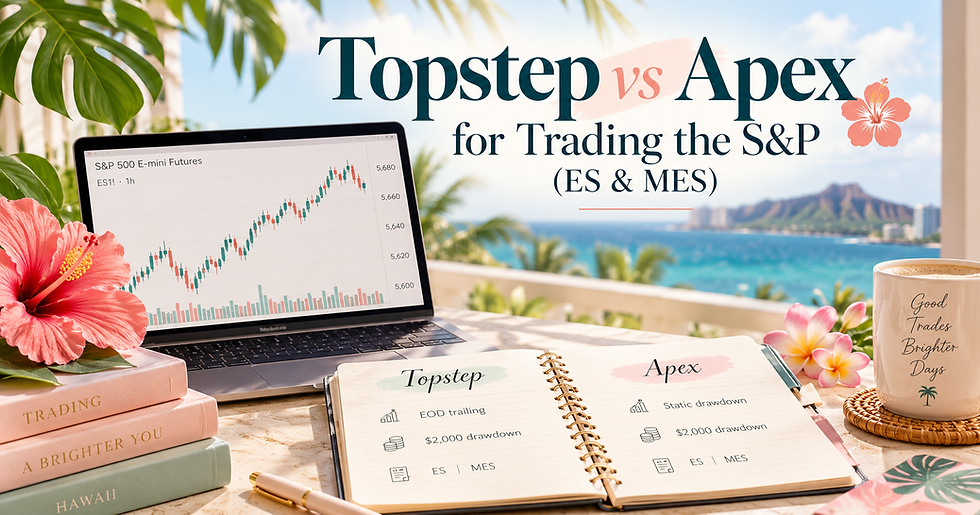
Both firms give you $2,000 of room. What changes is when that floor moves up behind you. This is the one rule you want to pay attention to.
End-of-day trailing (Topstep, and Apex's EOD account): the floor only moves based on where you close the day. What happens mid-trade doesn't count.
Intraday trailing (Apex's Intraday account): the floor chases your highest balance in real time, including open profit you haven't taken yet.
Here's what that looks like on a real trade.
You're in ES. It runs to +$1,000 unrealized. Then it pulls back, and you close at +$300.
End-of-day trailing | Intraday trailing | |
Floor before the trade | $48,000 | $48,000 |
Peak during the trade | $51,000 (open) | $51,000 (open) |
Floor after the trade | $48,300 (moves on close) | $49,000 (chased the peak) |
You closed at | $50,300 | $50,300 |
Room left | $2,000 | $1,300 |
Same trade. Same profit. But on intraday trailing, you just lost $700 of breathing room to a move you never banked.
That matters a lot if you trade like I do. I wait for the move, catch the second leg, and let price breathe. Intraday trailing quietly punishes exactly that. If you're a tight scalper who's in and out, it bothers you less.
Payouts and trading costs (the second layer)
Passing is not "hit $3,000 and withdraw $3,000." Both firms have a second set of rules before you see a dollar.
Topstep gives you two paths on the funded account. Standard: five winning days of $150 or more. Consistency: at least three trading days, with no single day over 40% of profit. You keep 90%. (Topstep payout terms)
Apex wants five qualifying days before a payout: $200+ per day on Intraday, $250+ on EOD. Your biggest day has to be under 50% of profit since your last payout. Payouts are capped per request, and the cap rises as you go.
Confused? Yea, no shit. It's not exactly simple, but workable if you really want to use them.
Commissions are a thing now
Futures don't have the pip-and-spread setup we're used to in forex. You pay per contract, per round trip (in and out).
On TopstepX right now, a round trip costs $3.78 for ES and $1.22 for MES. (TopstepX fees) Apex's costs depend on which platform you connect, so check yours before you trade.
10-point trade | Gross | Cost | Net |
1 ES | $500 | $3.78 | $496.22 |
1 MES | $50 | $1.22 | $48.78 |
On one trade, that's nothing. But if you're scalping MES twenty times a day, it adds up fast. Fewer, better trades win here too.
Side by side
$50K account | Topstep | Apex Intraday | Apex EOD |
How you pay | Monthly ($49 or $95) | One-time, heavy promos | One-time, heavy promos |
Time limit | None | 30 days, no resets | 30 days, no resets |
Profit target | $3,000 | $3,000 | $3,000 |
Drawdown | $2,000 | $2,000 | $2,000 |
Drawdown trails on | Day's close | Every tick, open profit included | Day's close |
Daily loss limit | Optional | None in eval | $1,000 |
Max size in eval | 5 ES / 50 MES | 6 ES / 60 MES | 6 ES / 60 MES |
Consistency in eval | Best day under 50% | None | None |
So which one should you choose?
If you're new to futures, start with Topstep's $50K and trade MES. That's where I landed.
Not because ES is different there- it isn't- but Topstep lets you learn futures without also learning seventeen varieties of prop-firm fine print at the same time. The drawdown only moves on your close. There's no 30-day clock. And if you blow it, a reset is $49, not a whole new account.
Clean!
If you like Apex's pricing, that's fair. Promos can make it cheaper to get in the door. Just pick the EOD account, not the Intraday one. Intraday trailing is built to punish exactly the kind of patient, let-it-breathe trading most of us are trying to learn.
And whichever you pick, please don't size to what the account allows. Size to the $2,000 daily limit.
The progression
This is the plan I'm actually following:
Chart and study ES. That's where the real liquidity and order flow live.
Execute with 1 MES. Prove the setup works on futures.
Step to 2 MES, then 3, then more, as the results earn it.
When you're comfortably running 10 MES, you're already trading the size of 1 ES.
No leap from "cute little trade" to "$500 a stop." Just a dial you turn up when you've earned it.
Prop firm rules and prices change constantly. Everything here was checked in early October 2026. Read the firm's current rules before you buy anything. This is my experience and research, not financial advice.


Comments